Nothing open that you did not open
No telnet, no shell password, no remote access left waiting. SSH stays off until you open a support window for 1 to 72 hours, on your own network only, and it closes itself when the time is up.
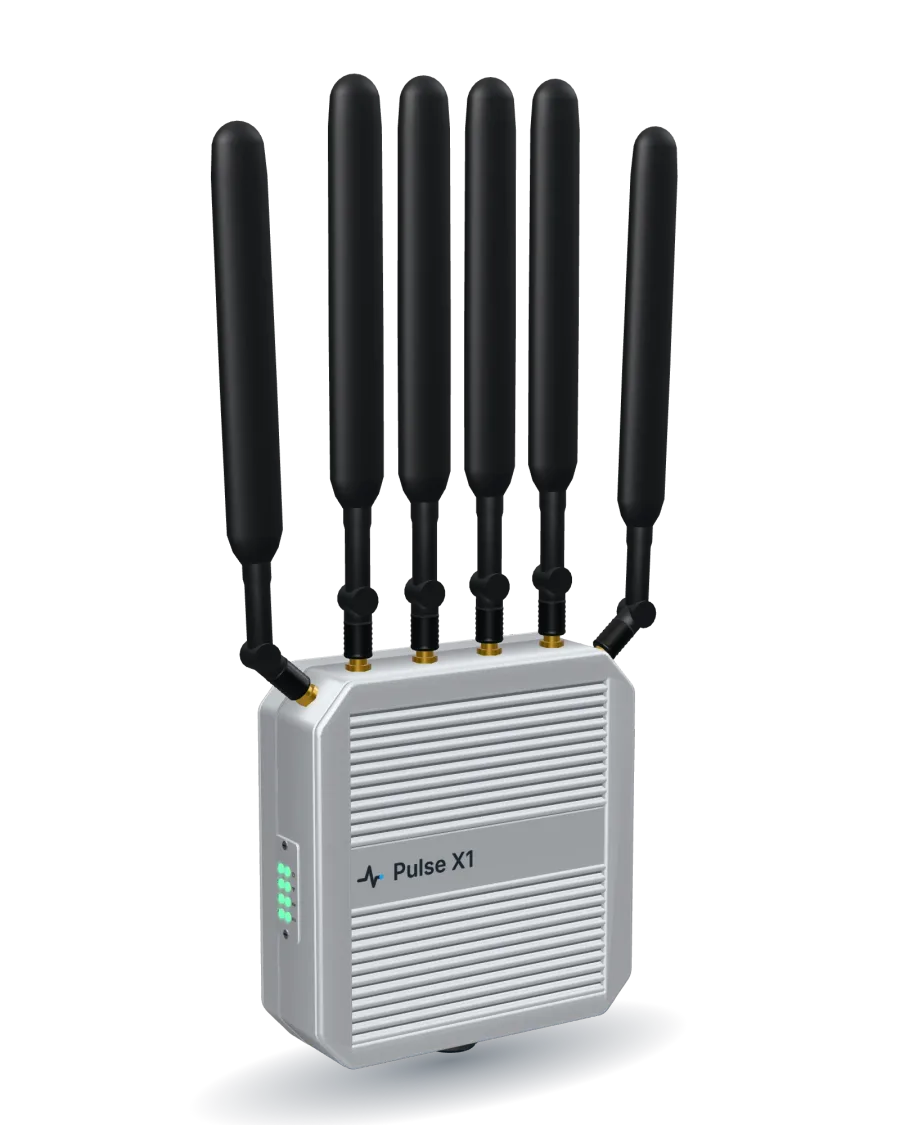
Pulse X1 brings standalone 5G, two SIM slots and Wi‑Fi 6 to a roof or a pole, in an IP66 aluminium body. Inside it runs PulseOS, our own firmware, built so nothing is open, nothing is shared and no update can leave it dead.
Security updates for seven years from launch, each one signed and checked before it installs.
No telnet, no shell password, no remote access left waiting. SSH stays off until you open a support window for 1 to 72 hours, on your own network only, and it closes itself when the time is up.
There is no shared default to look up. The X1 makes you choose your own password at the first sign-in, before any other screen opens, and refuses one made from its MAC address. Sign-in is HTTPS only, and each wrong guess after the fifth waits twice as long.
The X1 keeps two firmware slots. An update goes into the one that is not running. If the new version cannot get online, or nobody signs in, within 10 minutes and three restarts, the X1 switches back to the version that worked.
Every update is signed with Ed25519 keys kept apart from the machines that build it. The X1 checks the signature, the size and the checksum before it writes a byte, follows no redirects, and refuses an old release list replayed to hide a newer one. Security updates keep coming for seven years from launch.
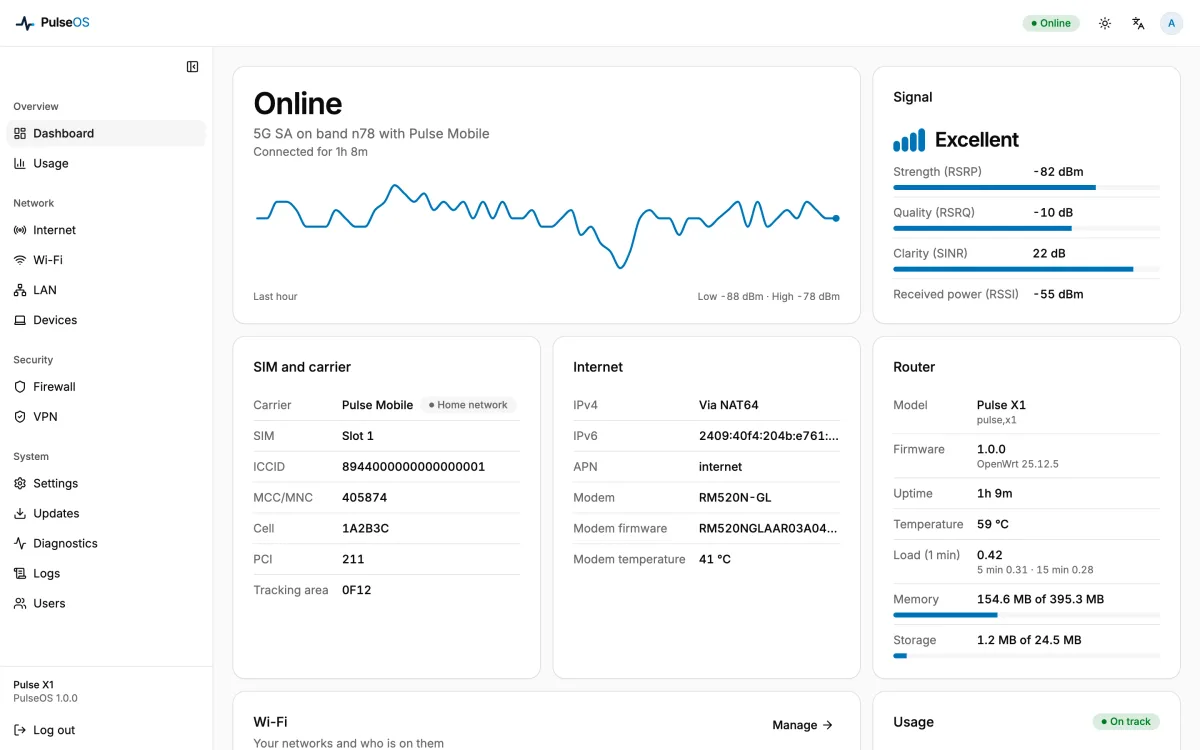
The signal bars weigh quality as well as strength, so they show a link that will actually work. The same lights show boot, update and recovery, help you aim the antenna, and can go dark at night.
Standalone and non-standalone 5G on six external antennas, two SIM slots, and a modem that is watched: if data stops coming in, the X1 resets the modem by itself, usually back online in under a minute.
Power and data arrive on a single PoE cable at up to 2.5 Gb/s. The aluminium body is the heat sink and is rated IP66, and the SIM slots sit behind a sealed cover.
Most routers are built to a price and patched rarely. These are the places where that shows, and what the X1 does instead. Each point links to its source.
| Topic | A typical router | Pulse X1 |
|---|---|---|
| Default password | In a 2024 study of 40 home routers, 18 did not make the owner set an admin or Wi‑Fi password, and some accepted “admin”, or no password at all, when setup was skipped. A 2022 study found hard-coded credentials in 21 of 109 firmware images.Ye et al., Exposed by Default, ACM AsiaCCS 2024; Fraunhofer FKIE, Home Router Security Report 2022 | No shared default. You choose your own password at the first sign-in, before any other screen opens, and one made from the unit's MAC address is refused. |
| Hidden ways in | The same 2024 study found an open but undocumented Telnet service on 2 routers and an undocumented SSH service on 4. Telnet logins with default passwords are how the Mirai botnet took over about 600,000 devices.Ye et al., Exposed by Default, ACM AsiaCCS 2024; Antonakakis et al., Understanding the Mirai Botnet, USENIX Security 2017 | No Telnet at all. SSH is off until you open a support window for 1 to 72 hours, on your own network, for Peppy Pulse's support keys only; it closes itself. |
| Signing in | Every one of the 40 routers in the 2024 study served its web interface over plain HTTP by default.Ye et al., Exposed by Default, ACM AsiaCCS 2024 | HTTPS only, with a certificate for each unit. After five wrong passwords each try waits twice as long, up to five minutes. |
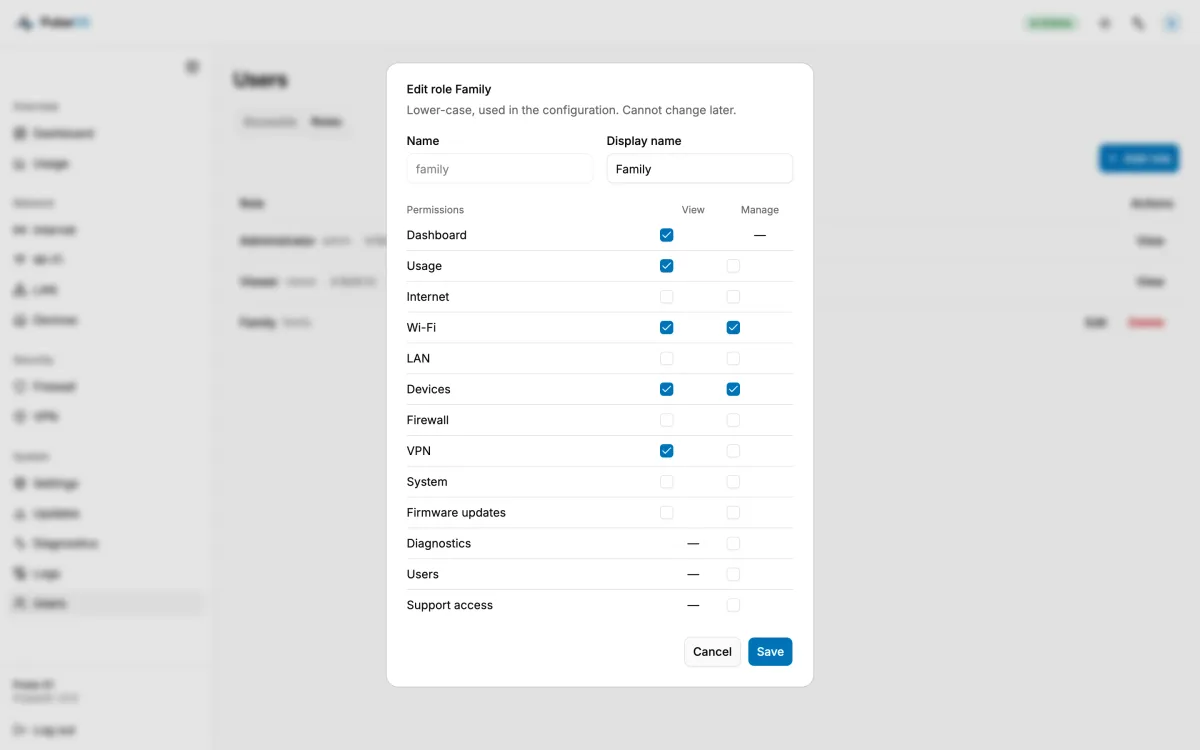
| The web interface | OS command injection tops MITRE's 2025 list of weaknesses exploited in the wild. By our reading of CISA's catalogue on 2026-11-18, it is behind about half of the exploited flaws listed for home and small-office routers.MITRE, 2025 CWE Top 10 KEV Weaknesses; CISA Known Exploited Vulnerabilities catalogue | The web app cannot run a shell command at all. It reaches the router through 18 typed interfaces, each with a JSON Schema and its own permission. |
| Updates | In the 2024 study, 7 routers downloaded firmware over plain HTTP, so an attacker on the path could swap the file, and 12 could not update themselves at all.Ye et al., Exposed by Default, ACM AsiaCCS 2024 | Every update and every release list is signed with Ed25519 keys and fetched over HTTPS with no redirects. The X1 checks for updates every day, and an old list cannot be replayed to hide a newer one. |
| Age of the software | In a 2022 test of 122 routers, 93 of the 121 Linux kernels found no longer received official updates, about three in four.Fraunhofer FKIE, Home Router Security Report 2022 | Linux 6.12, a long-term support kernel, on OpenWrt 25.12, the current stable series. |
| Support and reporting | Routers past their end of life stop getting security updates, and the FBI advises replacing them. Only about 4 in 10 makers of consumer connected devices give people a way to report a security flaw.FBI, end-of-life routers, PSA I-050725-PSA, 2025; IoT Security Foundation, State of Vulnerability Disclosure in Consumer IoT, 2025 | Security updates for seven years from launch, and a public address for reporting a flaw: security@peppypulse.com. |
A die-cast aluminium body with fins on both faces, six external antennas, and one PoE cable for power and data. Mount it on a wall or a pole where the signal is, and run the cable inside.
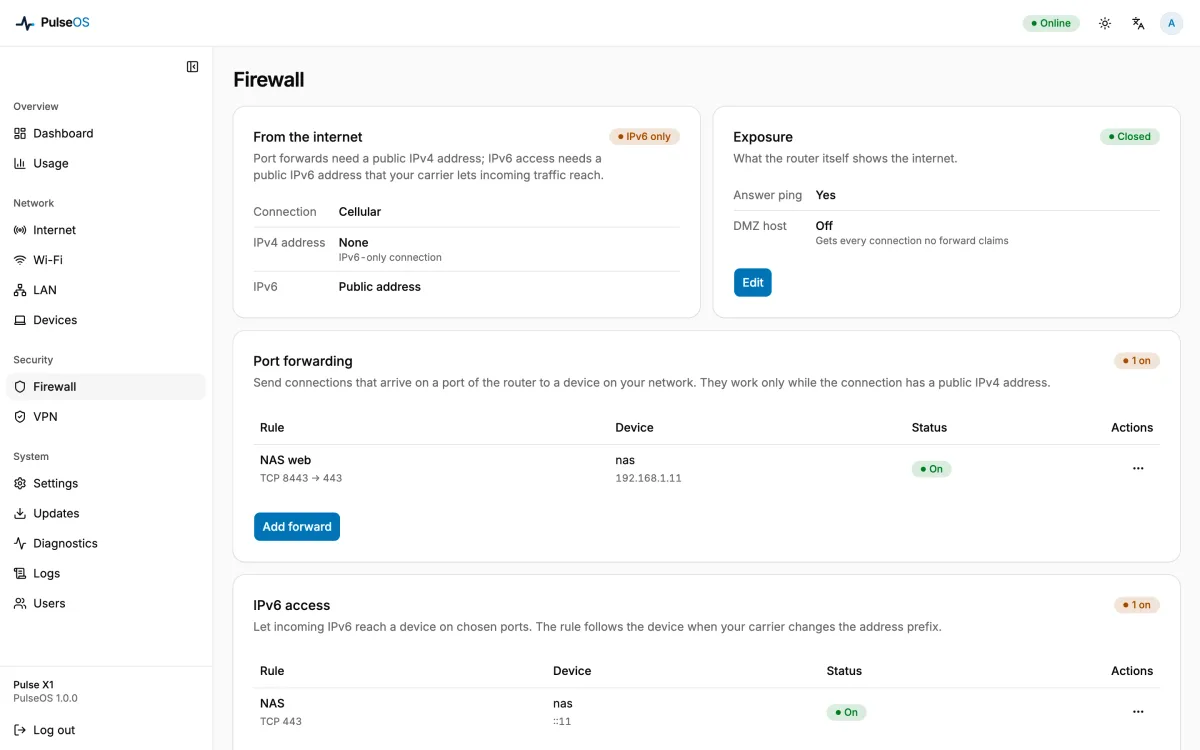
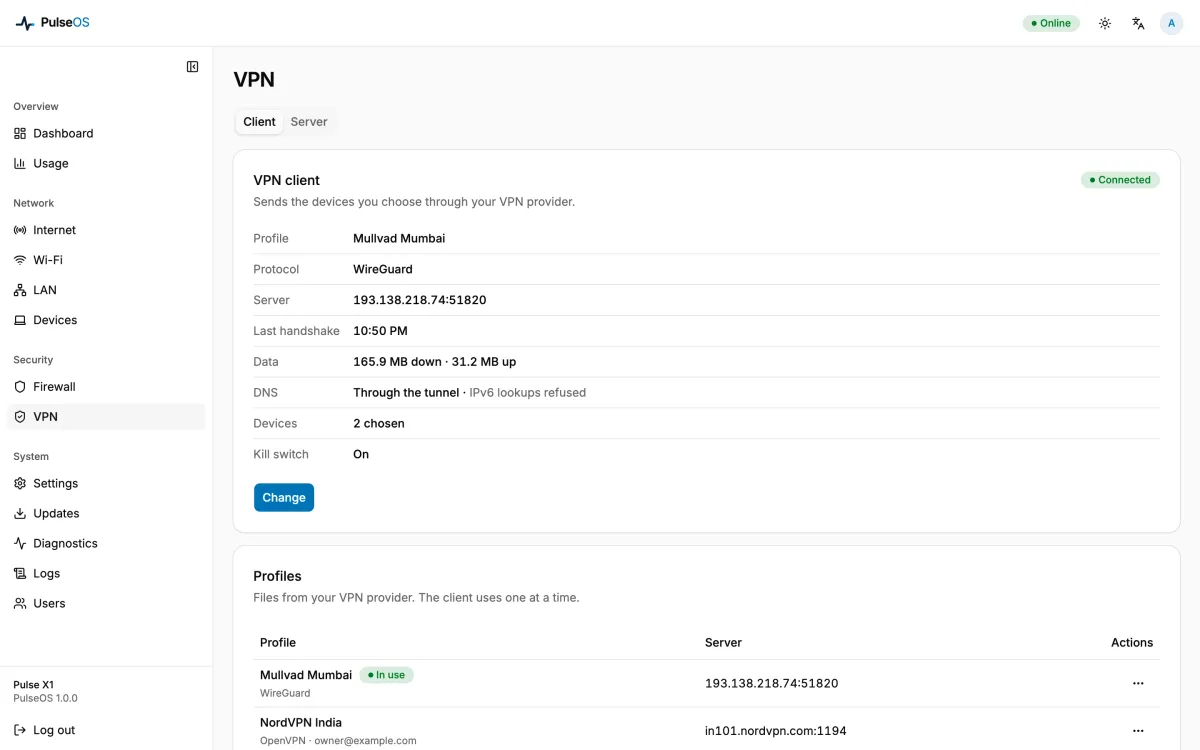
Full specificationsThe X1's web app answers four questions in order: am I online, how good is the signal, how much data have I used, and who is connected. It works on a phone, in light and dark, in English, Tamil and Hindi.
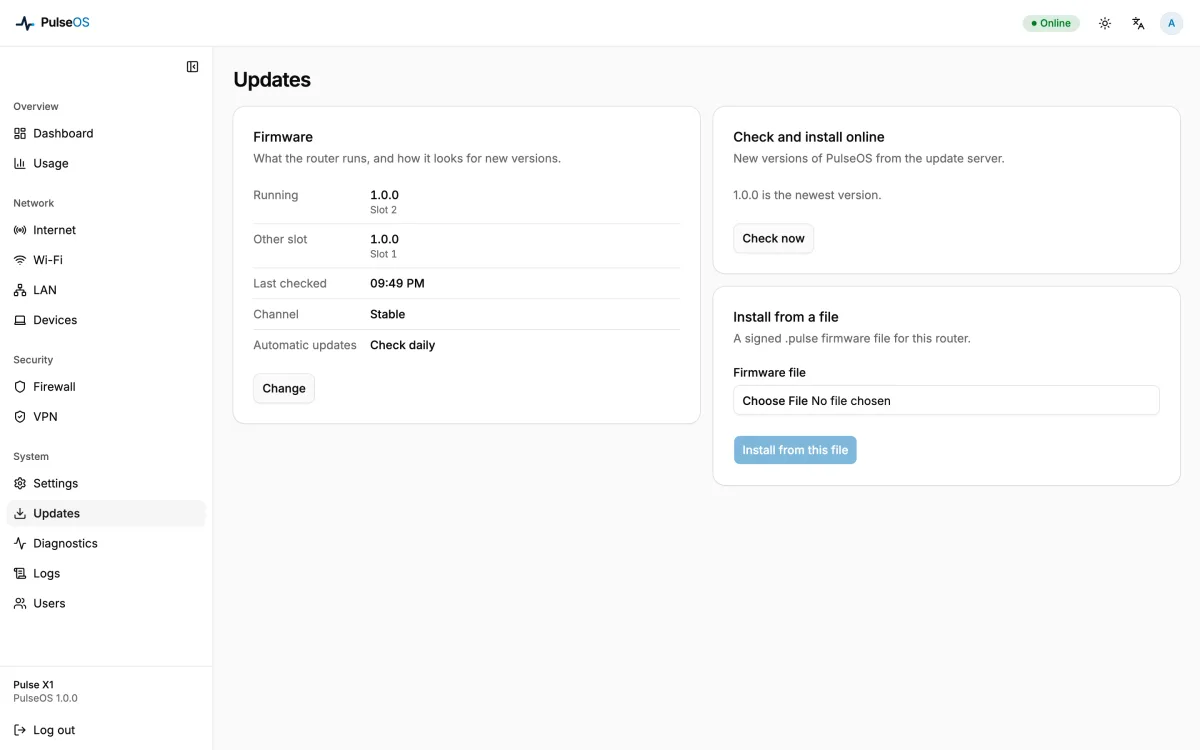
New versions come from Peppy Pulse's update server. This page checks each release's signature before it lists the file, and your X1 checks it again before it installs anything.
All channels and how to installWhen a signed build is published, it appears here with its checksum. Your X1 also checks for updates by itself every day.
Read from the update server on 2026-11-21, when this page was built.